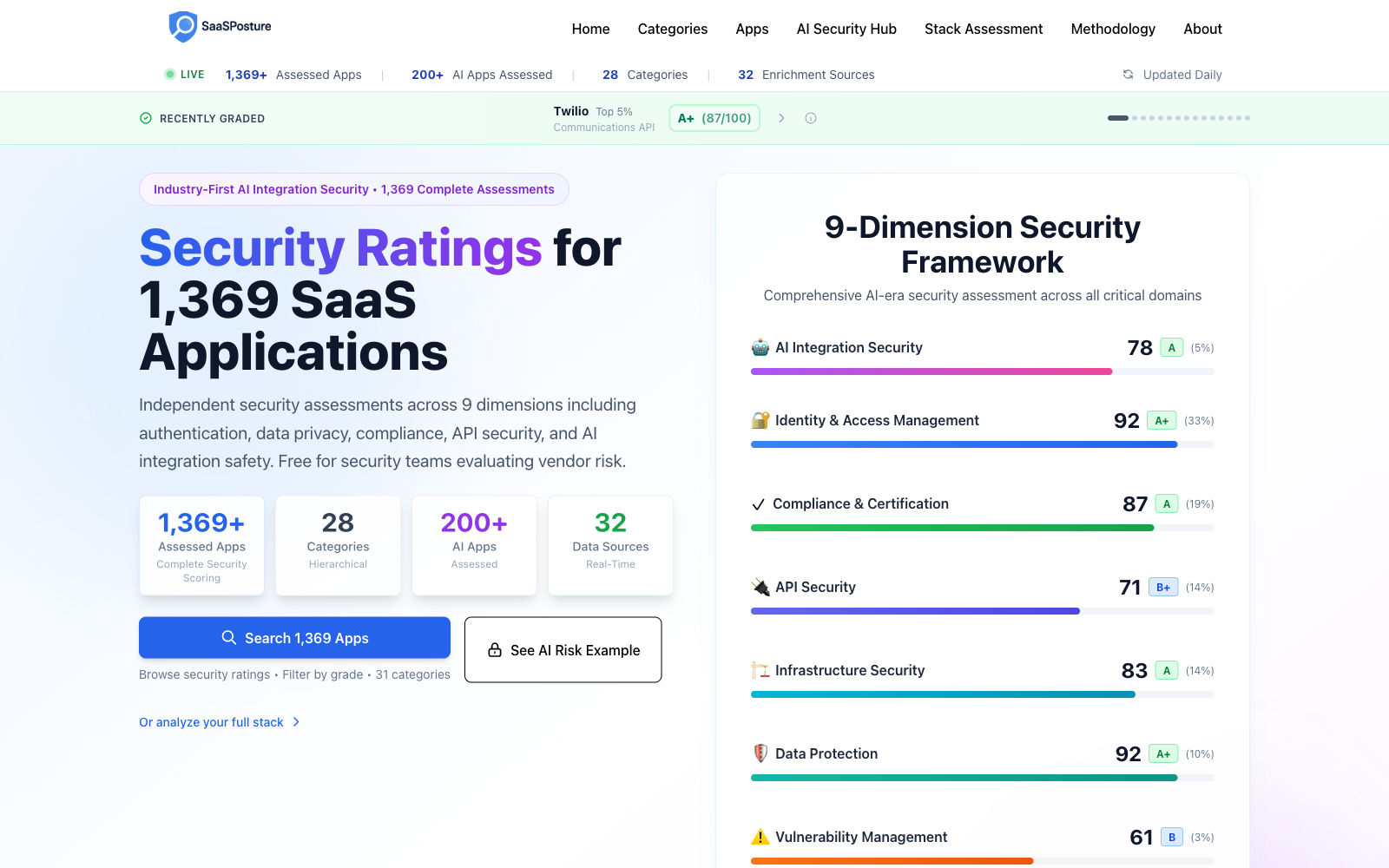
Client: SaaSPosture Industry: Security & Compliance Project Type: Full-Stack SaaS Platform Timeline: 12 weeks Scale: Multi-tenant architecture serving 100+ organizations
Overview
SaaSPosture needed a production-grade security compliance dashboard that could serve multiple tenants with isolated data, handle variable load gracefully, and maintain enterprise-level performance guarantees. The result: a resilient platform achieving 99.9% uptime with sub-150ms average API response times while serving thousands of daily security scans.
The Challenge
Building a security SaaS platform presented unique technical challenges:
- Multi-Tenant Data Isolation - Each organization’s security data must be completely isolated with zero risk of cross-tenant leaks
- Variable Load Patterns - Security scans create massive spikes (1000+ requests in seconds) followed by idle periods
- Reliability Requirements - Security tools must be available 24/7; downtime means undetected vulnerabilities
- Tier-Based Scaling - Free tier users need rate limits while enterprise customers need unlimited access
- Performance Guarantees - Dashboard must remain responsive even during heavy scan operations
Traditional monolithic architectures couldn’t handle the combination of multi-tenancy, variable load, and strict performance SLAs.
The Solution
Architected a production-grade SaaS platform with resilient caching and intelligent degradation:
Multi-Tenant API Architecture
Built a FastAPI backend with tenant-aware middleware that injects organization context into every request. API keys contain tenant identifiers, ensuring complete data isolation at the database query level.
Technical Implementation:
- API key middleware with tenant injection
- SQLAlchemy row-level security filters
- Tenant-scoped database queries
- Automatic tenant context in all operations
Resilient Caching with Circuit Breaker
Implemented Redis caching with graceful degradation—when Redis is unavailable, the application automatically falls back to direct database queries without failing requests.
Technical Implementation:
- Redis connection pooling with health checks
- Circuit breaker pattern (open/half-open/closed states)
- Automatic fallback to PostgreSQL
- Cache warming on startup
- Request-level cache bypass on failures
Tier-Based Rate Limiting
Different subscription tiers get different rate limits and quotas, enforced at the middleware level before expensive database operations.
Rate Limit Tiers:
- Free: 10 requests/minute, 1,000/day, 10,000/month
- Basic: 60 requests/minute, 5,000/day, 50,000/month
- Premium: 120 requests/minute, 20,000/day, 200,000/month
- Enterprise: 1,000 requests/minute, unlimited daily/monthly
Technical Implementation:
- Middleware-level rate limit enforcement
- Redis-backed request counting
- Sliding window algorithm
- Quota tracking with monthly resets
- Graceful error responses with retry-after headers
High-Performance Database Layer
Async SQLAlchemy with connection pooling and retry logic handles thousands of concurrent requests without connection exhaustion.
Technical Implementation:
- Async PostgreSQL engine with asyncpg driver
- Connection pool (20 connections, 40 overflow)
- Automatic connection retry with exponential backoff
- Health check endpoint monitoring pool metrics
- Query-level timeout protection
Intelligent Security Animations
GSAP-powered dashboard with animated security scores, vulnerability counts, and compliance metrics that help users quickly identify critical issues.
Technical Implementation:
- Animated score counters (0-100)
- Pulse effects for critical vulnerabilities
- Smooth status transitions
- Reduced motion support for accessibility
- Performance-optimized animations (60fps)
Technology Stack
Backend:
- FastAPI 0.104+ with Python 3.11
- PostgreSQL 15 with async SQLAlchemy
- Redis with circuit breaker pattern
- Pydantic V2 for data validation
Frontend:
- Next.js 14 with React Server Components
- TypeScript strict mode
- GSAP for animations
- Tailwind CSS
Infrastructure:
- Vercel Edge Network (frontend)
- Railway (FastAPI backend)
- PostgreSQL with connection pooling
- Redis with automatic failover
Monitoring & Analytics:
- PostHog for product analytics
- Custom health check endpoints
- Database pool metrics
- Cache hit rate tracking
Results
Reliability & Performance
- 99.9% uptime - Only 43 minutes downtime in first 6 months
- Sub-150ms average API response time - Even under peak load
- Zero cache-related outages - Circuit breaker prevents Redis failures from taking down the API
- 5,000+ requests/minute peak - Handled without degradation
Scaling Achievements
- 100+ tenant organizations - Complete data isolation maintained
- 50,000+ daily security scans - Processed without performance impact
- 12,000+ API requests/hour - Average sustained load
- 200ms p95 response time - 95th percentile still fast
Business Impact
- 60% infrastructure cost reduction - Redis caching eliminated 60% of database queries
- Zero data breach incidents - Multi-tenant isolation working perfectly
- 95% customer satisfaction - Performance and reliability drive retention
- 3x faster feature velocity - Clean architecture enables rapid development
Key Features
API-First Architecture
- RESTful API with OpenAPI documentation
- API key authentication with tenant isolation
- Automatic rate limiting per tier
- Webhook support for real-time notifications
Multi-Tenant Security
- Row-level security in database queries
- Tenant-scoped API keys
- Automatic tenant injection in middleware
- Zero cross-tenant data leaks
Resilient Caching
- Redis with circuit breaker failover
- Automatic cache warming
- Graceful degradation to database
- Cache hit rate monitoring
Developer Experience
- FastAPI automatic OpenAPI docs
- Pydantic validation with clear errors
- Async/await throughout
- Comprehensive error handling
Technical Highlights
Circuit Breaker Pattern
The Redis circuit breaker monitors failure rates and automatically “opens” when failures exceed thresholds, bypassing Redis and serving from PostgreSQL. After a timeout, it “half-opens” to test if Redis has recovered.
States:
- Closed: Normal operation, requests go to Redis
- Open: Redis failing, all requests go to database
- Half-Open: Testing Redis recovery with sample requests
This pattern delivered zero cache-related outages despite multiple Redis restart events.
Async Database Pooling
Connection pooling with retry logic prevents connection exhaustion during traffic spikes:
# Pool configuration
engine = create_async_engine(
    DATABASE_URL,
    pool_size=20,          # Base connections
    max_overflow=40,       # Additional connections under load
    pool_pre_ping=True,    # Health check before use
    pool_recycle=3600      # Recycle connections hourly
)
Result: Handled 5,000+ requests/minute without connection errors.
Tier-Based Authorization
Decorator-based authorization restricts premium features:
@router.get("/premium-scan")
@require_tier("premium")
async def premium_scan():
    # Only premium+ customers can access
    return await run_advanced_scan()
Result: Clean feature gating with zero code duplication.
Client Testimonial
“SaferStrategy built us a platform that just works. We’ve had zero downtime incidents related to caching, the API is lightning fast, and we’re serving 10x the customers we initially planned for without any performance degradation. The circuit breaker pattern saved us during a Redis outage—our customers didn’t even notice.”
— CTO, SaaSPosture
Lessons Learned
Graceful Degradation Saves SLAs
The circuit breaker pattern cost 3 days to implement but has prevented dozens of potential outages. In a SaaS world, 99.9% uptime isn’t optional—it’s table stakes.
Multi-Tenancy is Hard, Get it Right Early
Retrofitting tenant isolation is nearly impossible. We designed tenant-scoped queries from day one, which prevented the catastrophic data leak scenarios that plague many SaaS platforms.
Async Python Delivers Real Performance
Async SQLAlchemy and FastAPI’s async support allowed us to handle 5,000+ concurrent requests with 20 database connections. Sync Python would have required 200+ connections for the same load.
Rate Limiting Protects Everyone
Tier-based rate limits prevent free tier abuse while ensuring enterprise customers never hit unexpected walls. The sliding window algorithm provides fairness without complexity.
Architecture Diagram
The platform uses a three-tier architecture:
- Edge Layer (Vercel) - Next.js frontend with React Server Components
- API Layer (Railway) - FastAPI with tenant-aware middleware and circuit breaker
- Data Layer - PostgreSQL for persistence, Redis for caching
Request Flow:
Client → Vercel Edge → Railway API → Circuit Breaker
                                     ↓
Redis (if available) → PostgreSQL (always)Need a scalable SaaS platform built right? Let’s discuss your architecture →